2010 Peugeot 5 Concept HYbrid4 Technology

rsstou | 08:09 | 0 comments
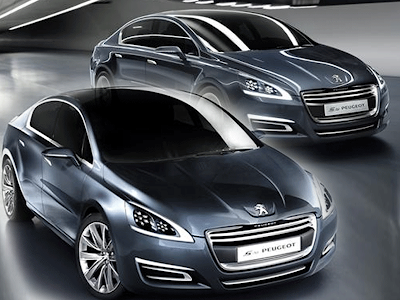
As part of its new Marque project, Peugeot is launching a double product offensive: the development of new markets and the strengthening of its presence in its historic market segments. The Peugeot 5 Concept car is another indication of the changing face of Peugeot and provides an insight into the Marque's future ambitions in the large luxury vehicle segment. Its pure and elegant lines blend with subtle technical detailing to create an overall effect of a timeless, exclusive and modern design.
2010 Peugeot 5 Concept HYbrid4 Technology

A 2.0 litre HDi FAP163 bhp diesel engine, mounted at the front of the vehicle, is combined with a 37 bhp electric motor at the rear. This arrangement provides an overall maximum power of 200 bhp, an electric only mode for low speed operation, four-wheel drive when required, and low fuel consumption and emissions of 74.3 mpg and 99 g/km of CO2 or zero in electric mode. Powered by the automaker's forthcoming HYbrid4 technology, the new 5 by Peugeot features a 163 horsepower 2.0-liter HDi diesel engine driving the front wheels and a 37 horsepower electric motor on the rear axle. This arrangement provides a peak output of 200 horsepower, an electric only mode for low speed operation, all-wheel drive traction when required and a fuel economy of up to 74.3 mpg.
2010 Peugeot 5 Concept HYbrid4 Technology

Its dimensions, proportions and styling are a direct response to the changing trends in the large luxury saloon car market segment. It reflects the continual search for more status, quality and performance, combined with a modernity that encompasses the vehicle's general efficiency in terms of architecture, engines and styling. The'5 BY PEUGEOT' expresses the Marque's vision and experience in the large touring car market. This concept car is designed and built to have both elegance and precision, but without in any way sacrificing the personality and dynamism so beloved of the Peugeot Marque. The emotion aroused by its exterior design holds the promise of exceptional interior space, convenience and comfort.
2010 Peugeot 5 Concept HYbrid4 Technology

At the front, the interpretation of the Marque's traditional feline appearance is spectacular; 'LED' lights are highlighted by the use of illuminated surrounds that blend perfectly with the overall exterior body styling. The headlamps frame a unique front grille design, whose visual appearance is closely influenced by the Peugeot SR1 concept car. The innovative design of the front grille gives the impression that it is detached from the vehicle; it appears to be suspended in front of the car. The new revised Lion badge naturally takes pride of place in a specially shaped area at the front of the long aluminium bonnet.
2010 Peugeot 5 Concept HYbrid4 Technology

The streamlined sides of the car are enhanced further by the bevelled, brushed-aluminium window surrounds and door handles, combined with sculpted 19'' wheel trims. The rear design of the vehicle suggests both robustness and power. The bold design of rear lights, consisting of three separate linked light clusters, clearly distinguish the vehicle at night, but also provides a link back to some of the Marque's historic models.
2010 Peugeot 5 Concept HYbrid4 Technology

Peugeot 5 Concept is further proof of Peugeot's environmental strategy. The modular technology of the Hybrid4 system can be combined with a range of naturally-aspirated engines according to market requirements, and can be fitted to different body shapes and different platforms, helping to ensure future driving enjoyment.
2010 Peugeot 5 Concept HYbrid4 Technology

The elegance, precision and dynamic appearance of the car's exterior styling is also reflected in the car's technical specification. The '5 BY PEUGEOT' concept incorporates Peugeot's HYbrid4 technology which, will be launched in 2011 in the Peugeot 3008.
2010 Peugeot 5 Concept HYbrid4 Technology

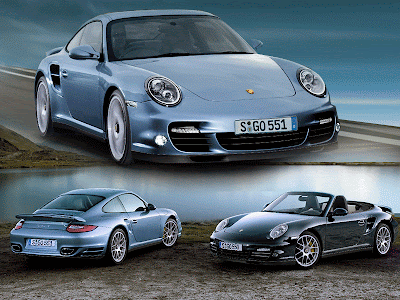
2011 Porsche 911 Turbo S The most efficient Sports Car

rsstou | 20:36 | 0 comments
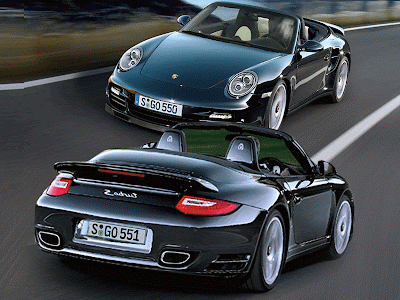
Hot on the heels of the facelifted 911 Turbo comes the more extreme 2011 Porsche 911 Turbo S, which will be making its world debut next month at the 2010 Geneva Motor Show before arriving in local showrooms in the second half of the year. The engineers at Dr. Ing. h.c. F. Porsche AG, Stuttgart, have developed a new top-of-the-range sports car for the customer who will only settle for the very best in terms of power, performance and driving dynamics: the 911 Turbo S. The heart of this most exclusive high-performance athlete is of course a six-cylinder boxer boosted by two exhaust gas turbochargers with variable turbine geometry, with an increase in power over the 911 Turbo by 30 to 530 bhp (390 kW). 
2011 Porsche 911 Turbo S The most efficient Sports Car

Maximum torque is a most impressive 700 Newton-metres (516 lb-ft). At the same time the 911 Turbo S comes as standard with all high-tech components available only as options on the regular 911 Turbo. In addition to its PDK transmission and all-wheel drive system, the latest 911 Turbo S gets Porsche’s dynamic engine mounts and torque vectoring system with a mechanical differential lock on the rear axle.
Despite its significant increase in power and dynamic performance, the new 911 Turbo S, at 11.4 litres/100 kilometres (equal to 24.8 mpg imp), does not consume any more fuel than the Porsche 911 Turbo, making it by far the most efficient sports car in its performance class.
 2011 Porsche 911 Turbo S The most efficient Sports Car

The 911 Turbo S comes exclusively with seven-speed Porsche-Doppelkupplungsgetriebe (PDK) (Porsche’s Double-Clutch Gearbox) conveying drive power to Porsche Traction Management (PTM) all-wheel drive. Driving safety optimised to an even higher standard is ensured by Dynamic Engine Mounts and Porsche Torque Vectoring (PTV) including a mechanical differential lock on the rear axle. In conjunction with Launch Control on the Sport Chrono Package Turbo likewise featured as standard, 911 Turbo S accelerates from a standstill to 100 km/h in 3.3 seconds and reaches 200 km/h in 10.8 seconds. Top speed is 315 km/h or 195 mph. Extra-light and fading-resistant Porsche Ceramic Composite Brakes (PCCB) provide the same outstanding performance in terms of stopping power and controlled application of the brakes.
2011 Porsche 911 Turbo S The most efficient Sports Car

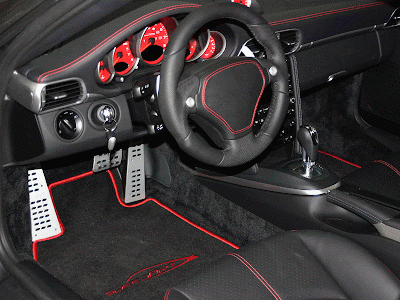
The supreme level of standard equipment including Dynamic Bending Lights, 19-inch wheels in RS Spyder design with central locking, a three-spoke sports steering wheel with gearshift paddles, adaptive sports seats, cruise control, a CD/DVD changer and exclusive twin-tone leather upholstery in Black/Crema or Black/Titanium Blue additionally underlines the outstanding class and calibre of this first Turbo S in five years.
2011 Porsche 911 Turbo S The most efficient Sports Car 

The 2011 Porsche 911 Turbo S will go on sale in Europe in both Coupe and Cabriolet variants this May and will arrive in the U.S. later in the year. Expect more details to be revealed following the car’s debut at next month’s Geneva event.

2010 SpeedArt BTR II 580 Sports Car

rsstou | 09:01 | 0 comments
Which is based on the Porsche 911 Turbo (997) 3.8-liter with PDK gearbox, the tuners at speedART have just launched the BTR II 580. As expected, the car underwent serious upgrades both in styling and performance, with pricing for the full kit going up to 21,630 euros. Taken separately, the BTR II 580 power kit costs 9,890 euros, while the body kit retails for 5,100 euros and the wheels go for 6,640 euros. According to speedART, the power increase of 80 hp and 120 Nm of torque was achieved by adding a modified motronic, a sport exhaust with 200 cell sport cats and big single race-tail-pipes. Moreover, the sport exhaust is also available with sound control switch.
2010 SpeedArt BTR II 580 Sports Car

The upgrades mean the BTR II 580 is now able to develop 580 hp and 720 Nm of torque. Thanks to Porsche's PDK transmission, the BTR II sprints from 0-100 km/h in 3.2 seconds and has a top speed of 325 km/h (202 mph).
2010 SpeedArt BTR II 580 Sports Car

The body kit consists of an optimized front chin spoiler for more downforce and better brake cooling, side skirts, rear diffuser, roof top spoiler and a rear spoiler wing. The BTR body kit is painted in a bi-color version with additional side stickers.
2010 SpeedArt BTR II 580 Sports Car

The visual and physical connection to road is given by the forged and weight reduced modular twin spoke wheels type „LSC FORGED (Light Spoke Competition)" in 8,5" and 12 x 20" with 245/30 and 325/25 ZR20" available in many different colors (for the rim and center star). Moreover, sportive and adjustable sport suspension comes in many different variations from type "street sport" up to or "race sport" including PASM function.
2010 SpeedArt BTR II 580 Sports Car

Additional modifications :
- sport steering wheel for all models and with F1 shift paddles for PDK
- Sport seats with carbon shell in leather, alcantara or special design variations
- special leather or alcantara applications
- carbon interior parts in many colors availiable

2010 McLaren MP4-25 Race Car

rsstou | 16:57 | 0 comments
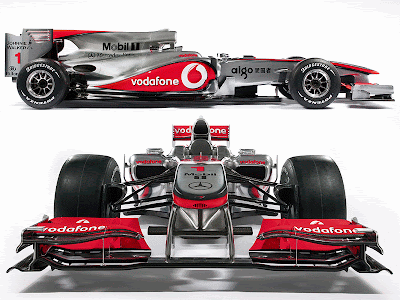
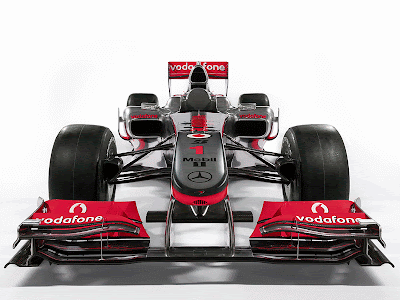
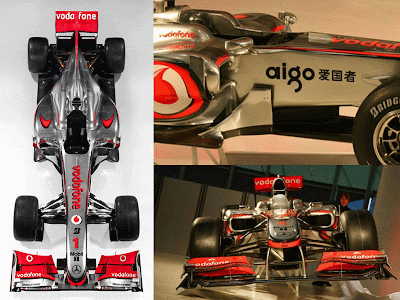
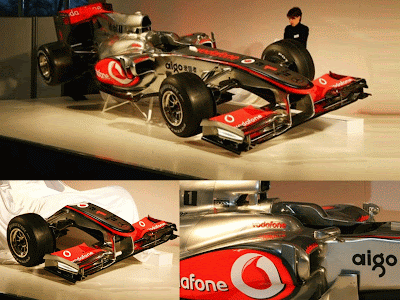
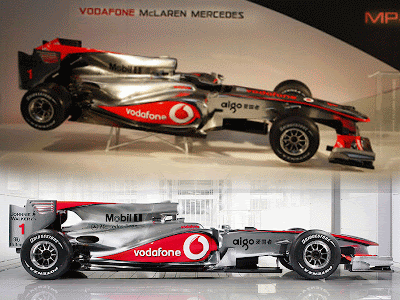
While yesterday was Ferrari's turn to present his car, McLaren did today. The team presented the MP4-25, the model that will run Lewis Hamilton and Jenson Button in the Formula 1 season starting on March 14 in Bahrain. The McLaren team that will be the last two world champions in Formula 1, Jenson Button and Lewis Hamilton. According to the company, the 'MP4-25', is a car that carries the British team has worked "more than ever" to tackle "an exciting year."
2010 McLaren MP4-25 Race Car   

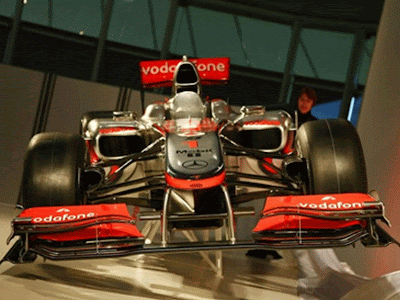
The McLaren Mercedes team launched its new car for the 2010 season on Friday morning, with the target of clinching both titles after a mixed campaign in 2009. The Mercedes-powered MP4-25 was unveiled at Vodafone UK's headquarters in Newbury. The Vodafone McLaren Mercedes team revealed its brand new MP4-25 chassis – the car in which reigning world champion Jenson Button and 2008 world champion Lewis Hamilton will contest the 2010 FIA Formula 1 World Championship.
2010 McLaren MP4-25 Race Car   

Unveiled at Vodafone UK’s stunning headquarters in Newbury, the 2010 car looks noticeably different from last year’s race-winning MP4-24. MP4-25 features a radical aerodynamic overhaul and a significantly larger fuel tank to take full advantage of this year’s new regulations, and its design team is confident it has explored every possible avenue to maximise the car’s performance.
2010 McLaren MP4-25 Race Car   

Horsepower once again comes from our friends in Stuttgart. Mercedes-Benz’s FO 108X V8 subtly improves upon an engine that has become the benchmark in Formula 1, winning the last two drivers’ world championships.
2010 McLaren MP4-25 Race Car   

The team kicks off its 2010 campaign with a stunning driver pairing: 2009 world champion Jenson Button and 2008 world champion Lewis Hamilton. It is the first time since 1989 – when it ran Alain Prost and Ayrton Senna – that the team has fielded a joint-world champion driver line-up, and marks the first time in Formula 1 history that the sport’s two most recent world champions have been partnered together.
2010 McLaren MP4-25 Race Car   

However, the driver line-up represents only a fraction of the team’s remarkable strength in depth. Members of the design team who contributed to the development of MP4-25 can also trace their involvement back through an incredible seven of the team’s 12 drivers’ world championships, five of the team’s eight constructors’ world championships and 112 of the team’s 164 grand prix victories.
The Vodafone McLaren Mercedes team begins pre-season testing with MP4-25 at the Circuit de la Comunitat Valenciana Ricardo Tormo on Monday.

2011 Third-generation Toyota Sienna Minivan

rsstou | 20:18 | 0 comments
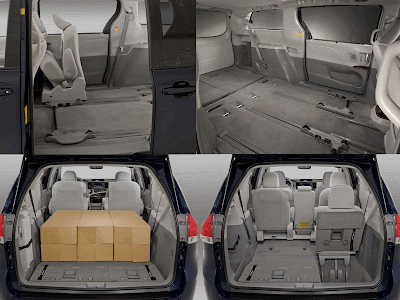
Toyota is the first carmaker in North America to be offering this innovation. The Auto Access Seat has a seat-mounted ingress/egress switch and a wireless remote control that allows for easy and flexible seat operation. The seat is able to rotate 90 degrees and can be lowered to within 19 inches of the ground to further facilitate easier passenger transfers at the exact height required. The Toyota Sienna is well known as a transportation solution for moving people and cargo comfortably and efficiently. The third-generation Toyota Sienna will look and drive more like a sedan, conform to new ideas about personal comfort, easily accommodate cargo, and handle big loads. The Toyota Sienna will come in five conveniently configured grades, all sharing a distinctly new visual direction and features. Toyota unveiled the all-new, third-generation Toyota Sienna minivan at a media conference at the 2009 Los Angeles Auto show.
2011 Third-generation Toyota Sienna Minivan

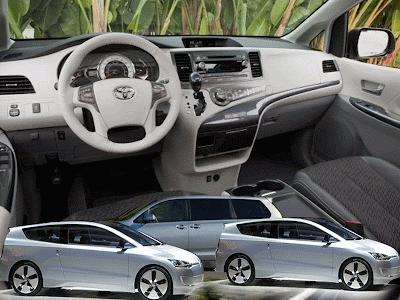
The 2011 Sienna has been reinvented to handle these needs as it shifts to a more expressive and dynamic vehicle with a stronger profile, high shoulder character and responsive handling. The 2011 Toyota Sienna may be the Japanese automaker's third-generation minivan, but Toyota emphasizes that the new Sienna is becoming more carlike than ever. The Sienna gets smart updates to its drivetrains and to its interior package for 2011-but not to its seating configurations, which still lag the class-leading Dodge Grand Caravan and Nissan Quest in flexibility. The Sienna is offered in a broad model range, and continues to be the only minivan with an all-wheel-drive option.
2011 Third-generation Toyota Sienna Minivan

The third-generation Sienna combines a contemporary style with features not previously seen in a minivan, and a fun-to-drive spirit that will surprise many, along with the flexibility, spaciousness and features that have defined the segment. The Sienna was designed by Toyota's Calty Design Research and developed at Toyota Technical Center in Ann Arbor, Mich., with assembly being accomplished at Toyota Motor Manufacturing, Indiana.
2011 Third-generation Toyota Sienna Minivan

A Toyota first rear-seat Dual View Entertainment Center is another innovative option. The system uses two displays side-by-side to create a seamless 16.4-inch widescreen image from a single source. When two separate entertainment options are called for, the system can split the screen into two individual screens, each with input from separate sources. Used as a single screen, it can be easily seen from the third row, and it can be operated from any seat via remote control. Used as two screens, the system can accommodate the preferences of two separate passengers who might want to play a video game or watch a second DVD simultaneously via auxiliary inputs.
2011 Third-generation Toyota Sienna Minivan

A choice of two responsive DOHC engines will be available: a 3.5-liter V6 or 2.7-liter four-cylinder engine. By adding the alternative of a four-cylinder engine, the 2011 Toyota Sienna is the first minivan in years to stray from the V-6-engine-only formula. Both engines offer the latest in efficient, lightweight technology, including Dual Variable Valve Timing with intelligence (VVT-i), roller rocker arms and an Acoustically Controlled Induction System (ACIS) that changes the length of the air-intake pipe to supply more torque on demand. 
2011 Third-generation Toyota Sienna Minivan

The 3.5-liter V6 makes 266 horsepower at 6,200 rpm, with expected EPA-estimated mileage ratings of 18 mpg city/24 mpg highway (16 mpg city/22 mpg highway on AWD models). It also has a 3,500-pound tow capacity. With 187 horsepower at 5,800 rpm, the 2.7-liter four-cylinder engine produces responsive power that exceeds some competitors V6 performance, while delivering expected EPA-estimated fuel efficiency ratings of 19 mpg city and 26 mpg on the highway. Given its upgraded engineering, every Toyota Sienna will ride well and track cleanly through corners, but none more so than the newest addition to the line: the sporty SE.
2011 Third-generation Toyota Sienna Minivan

The Limited is designed for customers who want all the features with more luxury. The standard equipment list is extensive, including new second-row Lounge Seating and a power 60/40 Split & Stow third-row seat, front and rear parking sonar, dual moonroof, Smart Key, and Safety Connect™. Select options include those available on the XLE plus HID auto high-beam auto-high beam headlamps, rain-sensing wipers, and Pre-Collision System (PCS) with Dynamic Radar Cruise Control.
2011 Third-generation Toyota Sienna Minivan

The Toyota Sienna will come in five grades: Sienna grade, LE, SE, XLE and Limited. All-wheel-drive is available with the V6 on LE, XLE and Limited models. The all-new 2011 Toyota Sienna will begin arriving at Toyota dealerships in February 2010.

2010 Ferrari F10 Specifically to compete in the Formula 1 World Championship

rsstou | 08:29 | 0 comments
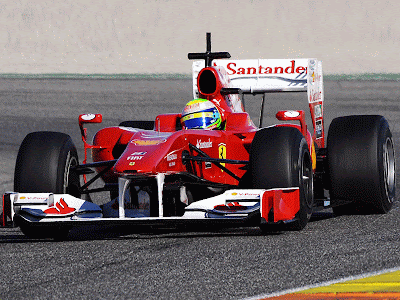
Scuderia Ferrari unveiled today its 2010 challenger, the Ferrari F10. The F10 single-seater was presented with a new livery, with both the front and the rear wing white painted. The F10 is the fifty-sixth single-seater built by Ferrari, specifically to compete in the Formula 1 World Championship. The name of the car renews the tradition of being linked to the year in which it makes its debut in the Championship. The project, which went by the internal code number 661, represents the Scuderia's interpretation of the technical and sporting regulations which apply in 2010. 
2010 Ferrari F10  Formula 1

The rule clarifications issued by the FIA during the course of the previous season as regards to the diffuser have opened up new scenarious for the designers in terms of freeing up this area, thus representing the opportunity to deliver potentially great performance advantages. Compared to the F60, the F10 was obviously conceived with the aim of maximizing the aerodynamic performance of the double diffuser. Therefore the engine mountings to the chassis have been modified in a specific way and also redesigned is the shape of the gearbox casing and the rear suspension layout.
2010 Ferrari F10  Formula 1

It only takes a quick glance to note that the front part of the chassis is considerably higher than on last year's car and that the central upper and lower surfaces are hollowed out, in order to improve airflow. Another major rule change is that race refuelling is banned, which means the fuel cell has to be big enough to allow the car to get to the end of the race, whatever type of circuit. Inevitably, the car is longer to accommodate the new fuel tank and to allow the installation of longer and narrower radiators so that the sidepods have a smaller higher aperture with a more cut-out shape at the bottom. A further tapering as been achieved thanks to a revised and unconventional configuration of the exhausts.
2010 Ferrari F10  Formula 1

The need to start the race with a much heavier car than in the past has required a redesign of the basic characteristics of the braking system, carried out in conjunction with Brembo as well as a new design for the relevant cooling system.
2010 Ferrari F10  Formula 1

Safety levels have been increased thanks to the introduction of new crash tests of the rear bulkhead and the cell with a full load. In light of past incidents and the fact that pit stops will take less time, the wheel nuts have been updated so as to increase security when the car is sent back out on track.
2010 Ferrari F10  Formula 1

Before its track debut, the F10 underwent an intensive dynamic and static bench test program. Significant developments on all areas of the car are built into the program, not just in the run up to the opening round of Bahrain, but throughout the entire year. 
2010 Ferrari F10  Formula 1

As always, much attention has been paid to the performance and optimization of the materials used, at the design stage and through quality control, in an effort to extract the maximum level of performance combined with the highest possible safety levels.

2010 Chevrolet Sports Car Camaro SS Indianapolis 500 Pace Car

rsstou | 20:08 | 0 comments
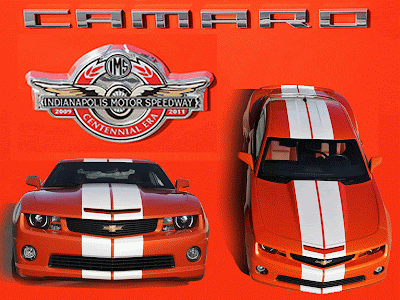
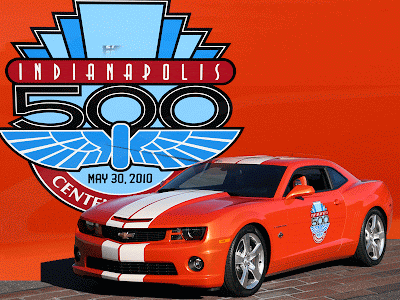
Chevrolet is supplying the Indianapolis 500 with a 2010 Camaro SS as a pace car. Unveiled ahead of the 2010 event which is taking place at the Brickyard on May 30, the Inferno Orange metallic muscle car will mark the sixth time a Camaro has paced the 100 year-old 500 since its debut in 1967. Officials from Chevrolet and Indianapolis Motor Speedway unveiled the 2010 Chevrolet Camaro SS Indianapolis 500 pace car at the Speedway's Hall of Fame Museum.
2010 Chevrolet Sports Car Camaro SS Indianapolis 500 Pace Car 

"We've enjoyed a great partnership with the Indianapolis Motor Speedway throughout the years," said Jim Campbell, General Manager, Chevrolet, "and are proud to once again have the privilege of pacing the Indianapolis 500 in a Camaro."
2010 Chevrolet Sports Car Camaro SS Indianapolis 500 Pace Car

The 2010 Chevy Camaro Indianapolis 500 pace car is a 21st century sports car that looks to the future with a nod to both the car's and the race's heritage. The first year for Camaro to pace the Indianapolis 500 was in 1967, the year the Camaro made its debut. Camaro has since paced the race in 1969, 1982, 1993 and 2009.
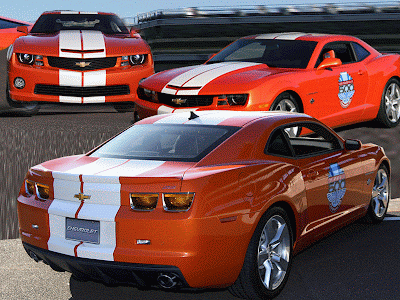
This year's pace car features an Inferno Orange Metallic paint scheme with White Diamond rally stripes that travel from the front to the rear over the top of the body, as well as extending to the instrument panel. The design is a modern interpretation of the original rally stripe that debuted on the 1969 Indianapolis 500 Pace Car.
2010 Chevrolet Sports Car Camaro SS Indianapolis 500 Pace Car

"Chevrolet has done it again with the 2010 Chevy Camaro SS Pace Car, it is simply beautiful," said Jeff Belskus, president and CEO of the Indianapolis Motor Speedway Corporation. "The car's tribute to '500' history and its sports car feel will be a big hit with our fans, and it will look great leading the Indianapolis 500 field on Race Day."
2010 Chevrolet Sports Car Camaro SS Indianapolis 500 Pace Car

The 2010 pace car is equipped with a stock 400 hp 6.2L V-8, an RS appearance package and leather interior with Inferno Orange interior accents. The pace car also features unique design cues that further enhance the Camaro's head-turning design. Features unique to the pace car include:
- 2010 Indianapolis 500 event logo painted on doors and embroidered on driver and passenger headrests
- 2010 Indianapolis 500 event logo badges on front fenders
- All-new front grille insert that Chevrolet plans to offer as a future Camaro accessory
- Amber lens tail lamps
- Complete safety strobe light system with custom interior light bar in the rear window (no rooftop light bar)
- All-new GM Accessory floor mats with red and orange accent stitching
 2010 Chevrolet Sports Car Camaro SS Indianapolis 500 Pace Car

Starting at approximately $23,000, and offering an EPA-estimated 29 highway mpg on the V-6-powered car, the all-new Camaro is a budget-friendly sports car that doesn't sacrifice on performance. Despite the recent economic challenges, the Camaro has overtaken its closest competitor to lead the regular sports car segment in sales for the last six months. Chevrolet sold more than 6,000 Camaros in each of these months.
2010 Chevrolet Sports Car Camaro SS Indianapolis 500 Pace Car

Established in 1909, the Indianapolis Motor Speedway has long prevailed as an icon of motorsports excellence. The 2009 racing season marked the 100th anniversary of the Speedway and the start of its Centennial Era, which continues with the 100th anniversary of the Indianapolis 500 Mile Race in 2011.
 
Support : Creating Website | Johny Template | Mas Template
Copyright © 2011. autodraaak - All Rights Reserved
Template Modify by Creating Website
Proudly powered by Blogger